British and World Marbles Championship
Six a side, forty-nine marbles, and a concrete ring in a pub car park in West Sussex that has been there since 1932.
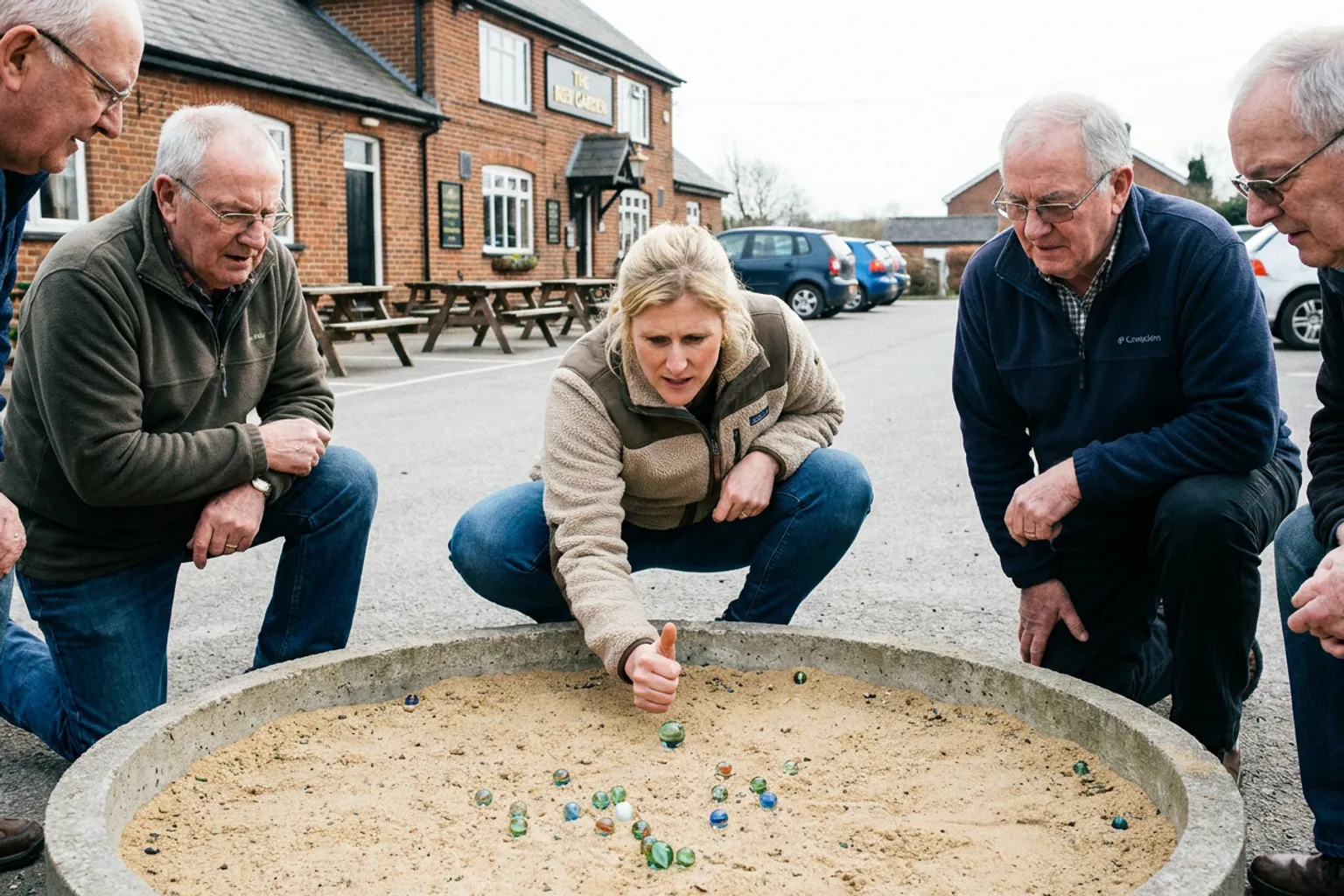
It happens every Good Friday outside the Greyhound at Tinsley Green, on a raised concrete ring six feet across, covered in sand, which is a permanent fixture of the car park and which people occasionally park on.
Teams are six. Forty-nine marbles go in the middle. You shoot a larger marble called a tolley, and if you knock one out of the ring you keep shooting. Twenty-five wins it.
The shot is the whole thing. You must knuckle down — the hand rests on the ring, the thumb does the work, and the hand may not move forward during the shot. Moving it forward is called fudging, and there is a man whose only job on the day is to watch for fudging.
Ray
I was not going to play. I had driven down to watch, because I had read about it and it was a Friday, and within about twenty minutes I had been asked whether I could shoot, had said no, and had been put on a team anyway, because the team was one short and the alternative was forfeiting.
Ray had played there since 1974. He looked at my hand, moved my thumb about four millimetres, and said “that’s it, that’s all of it”, and it was.
We went out in the semi-final to a side that had four of the same surname on it. I took eleven marbles across the day, which Ray described as “not embarrassing”, and which I have chosen to receive as the compliment it very nearly was.
They asked me to come back the following year as a reserve. I have been a reserve ever since. They have never once been a player short again, which I think about more often than a person should.