Twelve hours of lawnmower racing
An overnight endurance race on ride-on mowers in a West Sussex field, run since 1973 under a constitution that forbids prize money.
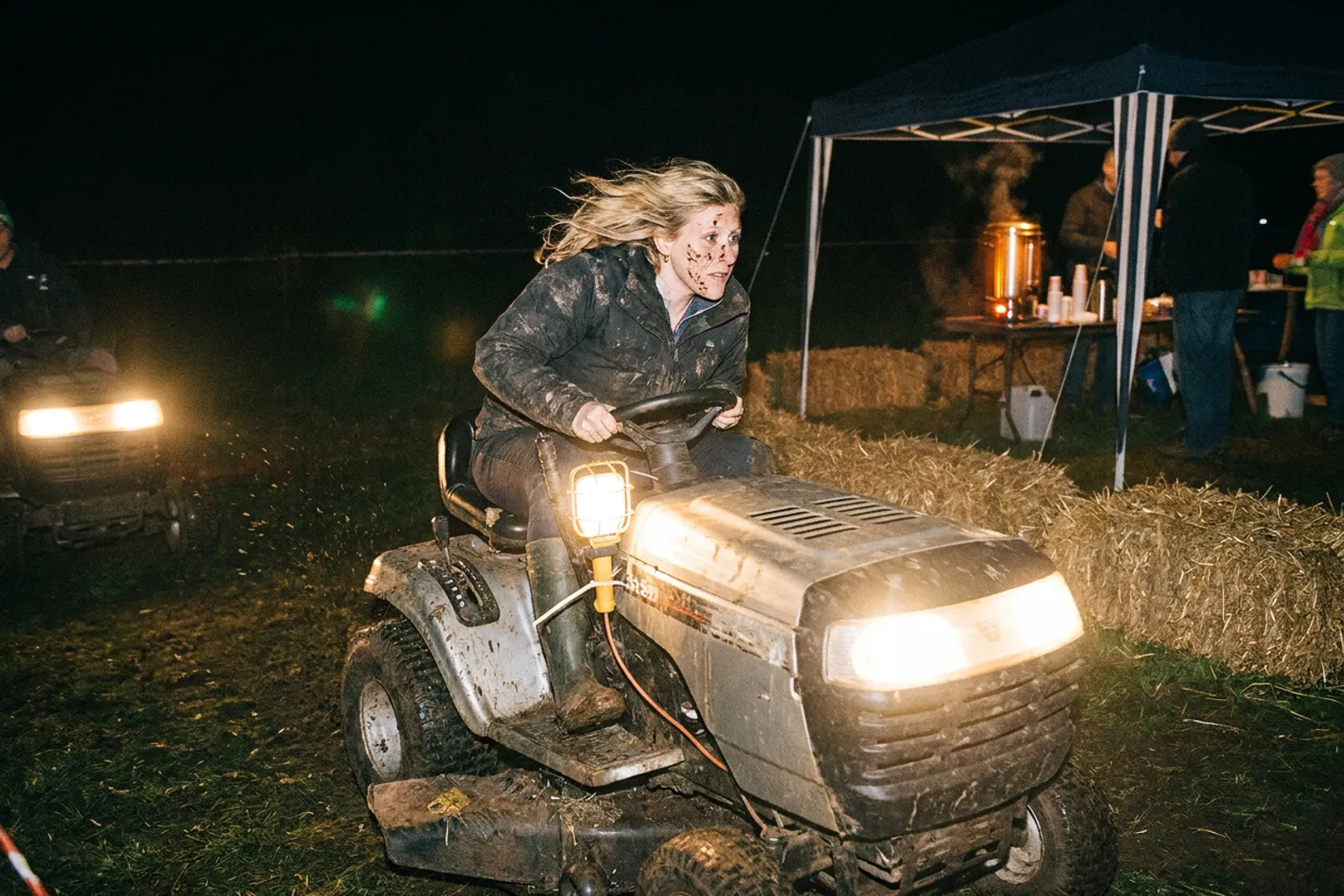
British lawnmower racing was invented in a pub in Wisborough Green in 1973 by a group who had worked out that motorsport was ruinously expensive and had decided to found one that could not become expensive. So it was written in from the first night: no sponsorship, no commercialism, no cash prizes. Fifty-two years later it has not been amended.
The blades come off. That is the first rule and it is the only rule anybody outside the sport ever asks about. What is left is a governed engine, a chassis that was designed to move at walking pace, and a field.
The twelve-hour endurance race runs from eight at night to eight the following morning. Le Mans start, three drivers a team, headlights taped on, and a pit area behind straw bales where somebody’s wife runs a tea urn all night.
Two in the morning
I was the third driver, which meets the definition of the phrase. My stint was two till four, which is the stint you give the third driver, and it is genuinely the best one — the field has thinned out, the grass has gone greasy with dew, and you can see three sets of headlights ahead of you and nothing else at all in any direction.
At twelve minutes past five, on my second stint, the engine made a noise that I have since had described to me as a con-rod, and then made no noise of any kind. I coasted it to the fence. It was not going to be repaired in a field at five in the morning and everybody knew that before I had stopped moving.
Nine hours and fourteen minutes. No classification, no points, and by constitution no prize money for anybody, which meant that standing over a dead engine in the half light I understood with total clarity what I had been competing for, which was nothing whatsoever, and I have rarely been happier.